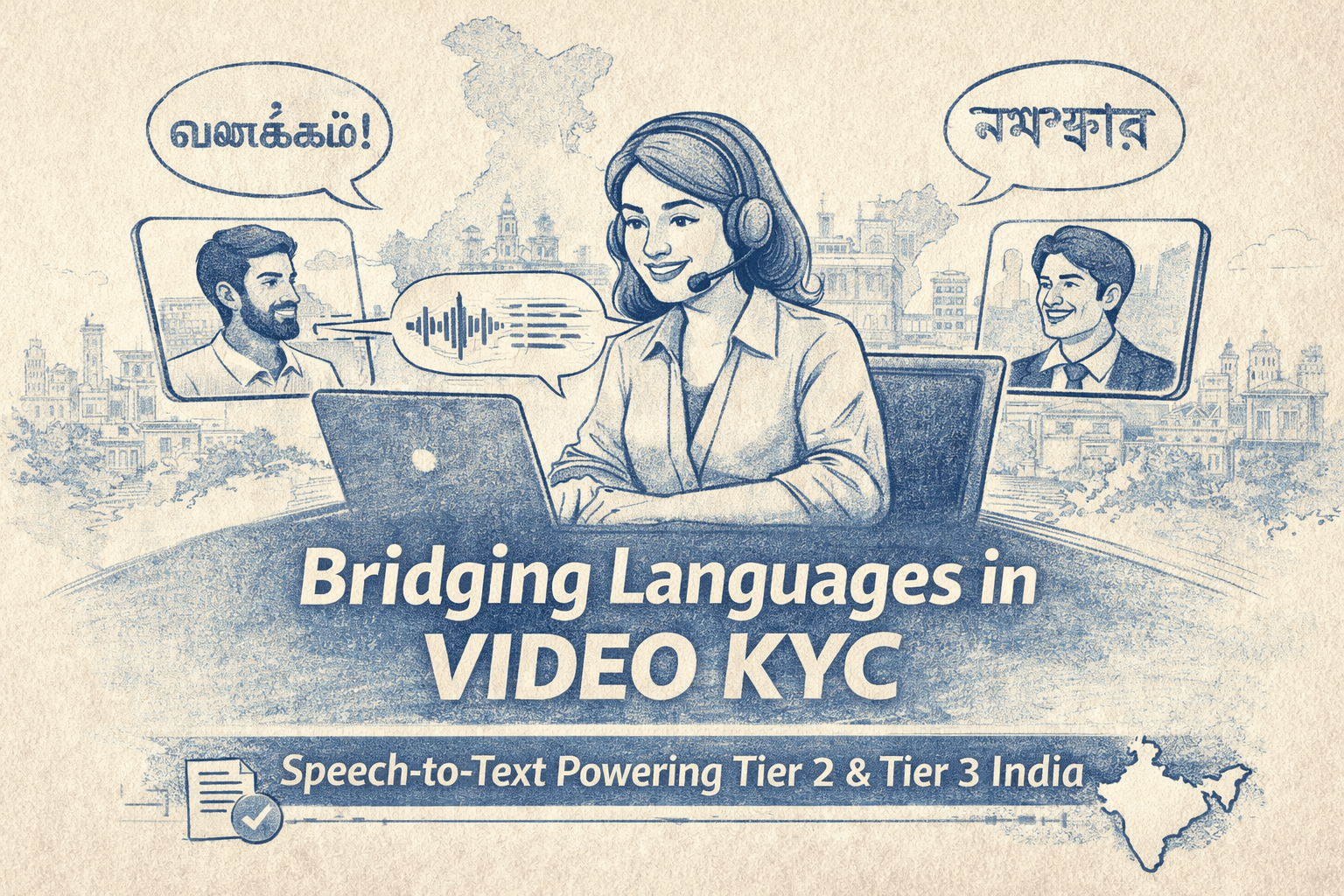
How Speech-to-Text Is Quietly Transforming Video KYC in Tier 2 & Tier 3 India
India doesn't speak one language. It speaks many.
When we built our Video KYC stack, we assumed identity verification was mostly about compliance, video quality, and fraud detection. But as adoption grew across Tier 2 and Tier 3 cities, something else became clear: language is infrastructure.
In cities like Indore, Madurai, Guwahati, Ranchi, or Kolhapur, customers are comfortable in their regional language. Many are not fluent in English or Hindi. Yet most verification agents are trained primarily in Hindi and English.
This is where Speech-to-Text inside a Video KYC flow becomes more than a feature. It becomes an inclusion layer.
The Real Challenge on Ground
A typical scenario:
A fintech expands into Maharashtra, Tamil Nadu, West Bengal, Assam, and Odisha. Their KYC team sits centrally with 15–20 agents.
Hiring dedicated agents for every regional language is expensive. Training is time consuming. Managing quality across languages becomes harder.
On calls, customers struggle to express themselves. Agents repeat questions. Calls stretch longer than needed. Sometimes the call drops because communication just feels exhausting.
Language becomes the invisible friction in onboarding.
Where Speech-to-Text Changes the Equation
During a live Video KYC call:
- The customer speaks in their preferred regional language
- The system converts speech into text instantly
- The agent views the structured text in their working language
- The conversation continues with clarity
Today, this is not full real-time audio-to-audio translation. The agent and customer are still speaking naturally in their own voices.
But the text layer acts as a safety net.
If either side struggles to understand a phrase, pronunciation, or accent, the transcript becomes the bridge. Semi-translation support helps clarify context. Even when full conversational translation is not perfect, the text backbone ensures nothing important is missed.
And yes, real-time voice-to-voice translation is on the roadmap. But even before that rollout, the current Speech-to-Text layer is already solving real operational gaps.
It is practical. It works within compliance. And it improves clarity immediately.
Why This Matters in Tier 2 and Tier 3 India
Comfort Creates Trust
KYC is sensitive. Customers share PAN, Aadhaar, and financial details. When they speak in a language they are comfortable with, hesitation reduces.
Small Agent Teams, Wide Language Coverage
Instead of hiring 8 different language specialists, a compact team can confidently handle multiple states with AI assistance.
This is powerful for small banks, NBFCs, insurance players, and fintech startups who want expansion without multiplying headcount.
Lower Call Time, Higher Success Rate
Speech-to-Text reduces repetition. Agents don't need to re-ask basic questions multiple times.
Even a small reduction in average handling time per call scales massively across thousands of verifications.
Built-In Documentation
Every call automatically generates a structured transcript.
That helps in:
- Compliance audits
- Dispute resolution
- Internal quality review
- Agent training
- Fraud analytics
Manual note-taking reduces. Focus shifts back to the customer.
Handling Semi-Translation Gaps
No AI system is perfect. Accents vary. Dialects differ within the same state.
There will be moments where:
- A phrase needs clarification
- A regional slang term is unfamiliar
- Pronunciation is unclear
In those moments, the Speech-to-Text transcript becomes a visual checkpoint.
Instead of awkward silence, the agent can confirm what was heard. Instead of restarting the conversation, they can validate one line.
It reduces friction without over-promising magic.
And when full real-time voice translation rolls out, this text foundation will already be strengthening accuracy and training datasets behind the scenes.
The Human Outcome
An agent in Jaipur can support a customer in Coimbatore. A customer in Siliguri doesn't feel excluded because they are not fluent in Hindi. A growing fintech can expand into five new states without rebuilding its operations team.
Speech-to-Text is not about replacing the human interaction in Video KYC.
It is about making sure language does not become a barrier to financial inclusion.
In a country as diverse as India, scale is not just about infrastructure and compliance.
It is about meeting people in the language they are most themselves in.
And building technology that listens carefully.